Saturday, February 26, 2022

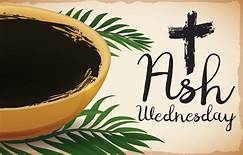
 Celebration of Ash Wednesday within the Mass 


Cycle C - Year II

2 March 2022: (Liturgical Color: Violet)

Readings:

First Reading:        Joel 2:12-18
Second Reading:   2 Cor 5:20--6:2

Gospel:  Please Read  Matthew 6:1-6, 16-18 

Repent and believe!

We take a break in our liturgical cycle of Ordinary Time to prepare for our Lenten journey. Today is Ash Wednesday, which ushers in the liturgical season of Lent.

Ash Wednesday falls 46 days before Easter Sunday.  Although it is not a holy day of obligation, by tradition Catholics attend Mass on this day in order to receive the blessed ashes.

Gospel Reflection

The Gospel proclamation is from St. Matthew. Jesus tells His disciples to be careful not to parade one's uprightness just to attract attention. Instead, the primarily concern is inner motivation for doing things and not the external action. Jesus wants us to do what is right and good because we truly desire to help others, love others, and make our world a better place. So Jesus criticizes those who do good just to be seen by others.

Blessing and Distribution of Ashes

After the homily, the presiding priest (or deacon) blesses the ashes by sprinkling them with holy water.  So now we know why it is Ash Wednesday because ashes are distributed during the Mass.  These ashes are from the burning of blessed palm branches of the previous year's celebration of Palm Sunday.

Then the faithful come forward to receive the blessed ashes. The priest dips his right thumb in the ashes and makes the sign of the cross with them on the forehead of each person, while saying these words:

"Remember, man, that you are dust, and to dust thou shalt return." Or,

"Repent and believe in the Gospel".

Lay Ministers may assist in the distribution of blessed ashes where there is a need, especially for the sick and the shut-ins.

A Day of Repentance

The symbolism of the distribution of the ashes reminds us of our own mortality, and calls us to repentance.  Usually, the faithful leave the markings of the ashes on the forehead all day as a sign of repentance and humility.

Fasting and Abstinence

The Universal Church requires us to fast and abstain from meat in keeping with the penitential nature of Ash Wednesday.

Fasting means eating only one complete meal and two smaller ones for the day, with no other food intake in-between.  Those required to fast are Catholics who are over the age of 18 and under the age of 60 years.

Abstinence means not eating any meat, or any food made with meat. Abstinence covers those with age of 14 and above.

A Journey of Hope

The Lenten Season is a fitting time to climb the holy mountain of Easter. It is a journey of hope towards our redemption from sin, when our Lord Jesus Christ rises again from the dead on Easter Sunday.

Ad Jesum per Mariam!


Sunday, November 28, 2021

 Caroling in our Paskong Pinoy


PASKONG PINOY is not complete without the spectacle of Christmas street carolers. It is said that caroling is an enduring and beautiful Filipino Christmas tradition. Once the month of December comes carolers will be on their feet singing carols from house to house spreading the spirit of the Christmas season through songs.

The usual scenario are children grouping together and going around house to house in the neighborhood to sing Christmas carols. Among the old time favorites are Jingle Bells, Silent Night, Hark the Herald Angels Sing, Silver Bells. Also, traditional Filipino Christmas songs add to their repertoire of songs, like Ang Pasko ay Sumapit, Pasko Na Naman, Himig Pasko, Namamasko Ko Po, and even the popular Christmas songs of Jose Mari Chan.

And then we see Filipino ingenuity comes naturally with the handmade musical instruments made from bottle tops for tambourine, or drums fashioned out from used cans or biscuit tins. The children are happy with whatever amount from the generosity of people is shared with them. In appreciation, they usually end singing... "Thank you, thank you, ang babait ninyo... thank you..."

Now, in our generation even adults are into caroling during the Christmas season. Church organizations, clubs, and other adult groups do their caroling to raise funds. They usually give a letter in advance to inform the date and time of caroling, and the beneficiaries of their funds. They come with more professional musical instruments, like guitar, drums, tambourine, and even portable musical organ. Their songs and singing are well-rehearsed. Indeed, itt must be a wonderful feeling not only to spread the joy of the Yuletide Season through Christmas songs. but also to raise funds for their organizations or causes and advocacy.

In our Paskong Pinoy tradition, Christmas carols make the Yuletide Season livelier and more spirited. Our Christmas carolers, both young and adults, remind us that Christmas is really giving and sharing, and manifests the Filipino spirit of generosity and magnanimity.

Recall that at the height of the pandemic last year, we sorely missed Christmas carolers as civil authorities imposed lockdowns to prevent the spread of the pandemic. With the easing of pandemic restrictions this year, Christmas caroling will be allowed in areas under Alert Level 2 according to government authorities. Let's celebrate that this beautiful tradition of Paskong Pinoy is coming back this year.

TRIVIA:

There is no definitive history behind Christmas caroling. Where they originated, who wrote them, and how they evolved is unclear. Caroling is an oral tradition passed down from generation to generation.

Nonetheless, some historical accounts claim caroling is rooted in feudal societies, when poor citizens would "sing" for their supper in exchange for food or drink. Another theory is that carolers traveled door-to-door because they were not originally allowed to perform in churches. These are but stories and they don't have factual basis.

BUT regardless of its origin, our Paskong Pinoy is bleak without our usual Christmas carolers, the children and adults.

 WE wish you a Happy and Beautiful Christmas Caroling! Namamasko po!


Ad Jesum per Mariam!


 The Belen in our Sto. Nino Chapel


Christmas celebration this year seems brighter than it was at the height of the pandemic last year. With the easing of pandemic restrictions by civil authorities, we can return to our traditional way of celebrating the Christmas Season.

We celebrate with joy that Holy Mass in our chapel will resume soon at the start of the Misa de Gallo on December 16. Let us praise the Lord for this Christmas blessing, even though we still need to observe certain guidelines on safety protocols mandated by IATF.

In our small community, Christmas season is welcome back with the display of the Belen in the altar of our Sto. Nino Chapel. Because the Belen symbolizes the family spirit in our community during the Christmas Season. It brightens our celebration of the early morning nine-day novena Masses or Misa de Gallo. The Belen was not seen last year as there was also no liturgical activities allowed in the chapel since the start of the pandemic. And Christmas without the Belen is bleak.


So what is the significance of the "Belen" on Christmas Season?

The Belen, or the Christmas Nativity scene, (sometimes also called the Manger) is probably one of the most recognizable symbols of the Christmas Season.

The word "nativity" is from the Latin word "nativus" which means "arisen by birth".

The Christmas Nativity Scene generally has same elements of the child Jesus in a manger; His mother, Mary; His earthly father, Joseph; shepherds; an angel; various barn animals; and sometimes the three wise men or Magi.

The Belen depicts the nativity scene, or birth of Jesus Christ in Bethlehem. It reminds everyone, and especially the poor and the less fortunate, about God's begotten Son, our Lord Jesus Christ, who took on our human form to redeem humanity. The infant Jesus in the manger helps to contemplate the mystery of God's love who revealed Himself in the poverty and simplicity of the Bethlehem cave.

The crib or the baby Jesus in a manger, can help us to understand the true meaning of Christmas as it speaks of humility and the merciful goodness of our Lord Jesus Christ, who "though He was rich, yet for our sake He became poor."

We look forward with much joy the veneration of our Belen in the chapel as we begin our 9-day novena-Masses during the Misa de Gallo at 5:15 in the morning. Come, let us adore the Baby Jesus in the manger.

Biblical trivia:

It is said that St. Francis of Assisi created the very first nativity scene in 1223 in his effort to promote the true meaning of Christmas and worship of Jesus Christ. His idea caught on, and soon a new Christmas tradition was born.

In the Philippines, the Belen was introduced to Filipinos by the Spaniards in 1565.

A BLESSED AND MERRY CHRISTMAS TO US ALL!


Ad Jesum per Mariam!


Wednesday, November 24, 2021

 The Advent Wreath


The Advent Season is the beginning of a new liturgical year for the Church.  It is also our preparation for the BIG event that is Christmas Day.  This year the Advent Season starts on November 28, First Sunday of Advent.

We see a beautiful symbolism of Advent in churches and chapels, including most homes and offices, in the Advent Wreath. It is also one of the most popular traditions during the Advent Season.

Each part of the Advent Wreath symbolizes our spiritual preparation for the birth of the world's Messiah, Jesus Christ on Christmas Day.  The Advent Wreath is made up of various evergreens traditionally in a circular shape symbolizing eternal life.  Also, the circle of the wreath, which has no beginning or end, depicts the eternity of God, the immortality of the soul, and the everlasting life found only in Christ, the eternal Word of the Father.

The four candles in the Advent Wreath refer to the four weeks (or four Sundays) of Advent.  According to tradition, each week represents one hundred years, to sum up to the four thousand years from the time of Adam and Eve until the birth of the Savior. Each candle is lit on each Sunday of Advent.

Three of the candles are color purple and one is color rose.  In particular, the purple candles symbolize  the prayer, penance, and preparatory sacrifice, and the good works the faithful undertake at this time in preparation for Christ's birth.

The rose candle is lit on the third Sunday of Advent, which is called "Gaudete Sunday", or the Sunday of rejoicing.  It is so because the faithful are now at the midpoint of Advent by this time, when their preparation is now half over and they are close to Christmas Day.

The progressive lighting of the candles symbolizes the expectation and hope surround our Lord's first coming into the world and the anticipation of His second coming to judge the living and the dead at the end of time.

BLESSING OF THE ADVENT WREATH:

The following prayer maybe used to bless the Advent Wreath:

"O God, by whose word all things are sanctified, pour forth Thy blessing upon this wreath, and grant that we who use it may prepare our hearts for the coming of Christ and may receive from Thee abundant graces, who livest and reignest forever. Amen.

PRAYERS FOR THE LIGHTING OF THE ADVENT WREATH: 
(Usually at the start of Sunday Mass)

1st Sunday of Advent:

Father, as we begin our Advent pilgrimage, we light a candle of Hope. Grant us the courage to hope: hope for Your presence, hope for Your peace, hope for Your promise. Amen.

2nd Sunday of Advent:

Father, as we journey down the Advent road, we re-light the candle of Hope, and we light the candle of Peace.

Grant us the courage to make peace: peace in our hearts, peace in our homes, and peace in our communities. Amen.

3rd Sunday of Advent:

Father, at the height of our Advent walk, we re-light the candles of Hope and Peace, and we light the candle of Joy.

Grant us the courage to experience joy in the hope of the Savior's coming: joy in the face of apathy, joy in the face of sorrow, joy in the face of uncertainty. Amen.

4th Sunday of Advent:

Father, as our Advent pilgrimage draws to a close, we re-light the candles of Hope, Peace, and Joy. And we light the candle of Love.

Grant us the courage to share Your love: love for life and all creation; love for sinners and saints; love for the poor and the little ones.  We thank You for the hope Your Son gives us, for peace He bestows, for the joy Your Spirit pours into our hearts, and for Your love that redeems us and shows us the way. Amen.

Finally, may the Advent Wreath in our churches, chapels, offices and homes remind us that Christ is the Light that came into our world to dispel the darkness of sin and to radiate the truth and love of God.


Ad Jesum per Mariam!